
Vital Strategies’ Mary-Ann Etiebet on Global Health’s Fundamentals

She calls it her “baptism by fire.”
Mary-Ann Etiebet took charge of the global public health organization Vital Strategies just four months before U.S. government cuts and sweeping policy changes upended global health last year. The CEO, who previously led Merck for Mothers, as well as PEPFAR programs in Nigeria, says the cuts have cost lives and livelihoods.
They also have caused “tectonic plate shifting in global health and global health financing,” she says, with mixed results. “We as a global health community need to move away from a scarcity mindset, where we’re all fighting over a slice of the pie.” Instead, she argues for “a community-strength mindset where we’re thinking through, how can we actually increase the pie? What investments can we make together?”
In this Q&A, Etiebet discusses health taxes' "triple win effect," fundamental data systems, and other means of advancing public health.
We’re roughly 18 months into the Trump administration’s overturning of global health funding models. Do you see any positives?
Out of this crisis comes an opportunity to hold up the mirror to ourselves and see what we could do differently. We see governments now articulating what their priorities are and being in the driver’s seat—where they should have been from the get-go.
I come from vertical programs. I worked in HIV with PEPFAR. I worked on maternal health from a funding perspective. And coming from Nigeria and working in global health these past 25 years, I know that when the funding stops, the work stops. We saw this 18 months ago with the implosion of USAID. And that should not be the case. When the [donor] funding stops, the work and the impact should still be sustained if we do it the right way. The right way is about supporting and investing in foundational health systems so that this work can be carried through—with or without donor funding.
You’ve advocated for health taxes as a strategy that governments should embrace. Why?
We know that if governments enact health taxes to increase the price of tobacco, alcohol, and sugary beverages by 50% globally in five years, we could get $3.7 trillion. This could support up to 40% of national health budgets in low- and middle-income countries. So, there are solutions.
What I hope is that we will learn our lesson from what has happened. And moving forward, we will be creating the types of partnerships and global health financing reform needed to make sure that something like this does not happen again.
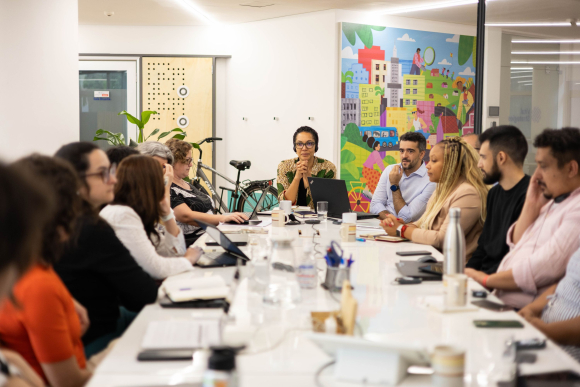
Vital Strategies CEO Mary-Ann Etiebet confers with colleagues in Brazil in October 2025. Courtesy: Vital Strategies
Have health taxes been getting traction?
Since last year, we’ve seen countries pushing on these issues. Senegal has passed additional legislation on tobacco. We’ve seen Ethiopia and Rwanda’s efforts on the three commodities. South Africa just passed a bill on sugary beverages. Not all of these have had the taxes at the level that we would want to see them, but progress is progress. And we’re excited that not only are countries developing and drafting these policies, but they’re actually getting them passed.
Vital Strategies acquires data and evidence to advocate for strengthened health systems, strong government policies, health taxes, etc. Many governments aren’t moving necessarily in those directions. Do you feel like you’re swimming against the tide?
Short answer: yes. To your point, passing policies is hard. It can take years. There has to be the right political environment, but we’ve seen that with sustained pressure, there can be success.
I always like to say, “Let’s do the hard things.” The opportunity is now, as we are thinking about how to do global health and global health financing differently. My hope is that there will be more attention paid to prevention, policy solutions, having the data inform how we allocate resources and how we prioritize at the local level, and making sure that we’re doing this in dialogue with the public, so we have public support.
We’re also very focused on helping governments build foundational public health data systems that can track patients across time and across points of service.
Tell us more about that.
To date, governments have not had the public health data infrastructure to be able to say to donors, “You’re not actually having the impact we need you to have. You’re not reaching all the population we need you to reach.” Or, “Your work is actually exacerbating inequities.” If these foundational data systems are in place, where everybody is connected to a national digital public infrastructure, there’s transparency, and we know the denominator so we can really speak to equity, and we can hold partners to the same metrics and the same data.
You’re making the case for investing in birth and death registries, national ID systems, etc. But governments are facing immediate, critical issues like surging noncommunicable diseases (NCDs). It’s got to be hard to say to governments, stop everything and invest in these data systems.
First things first, you know. One of the reasons we have not seen as much investment in NCDs as we would like is because the data has not been there. Most of the NCD data is all modeling and estimates, so it’s easier to discount it. But if you have a national report that says these are the things that are killing my people, that’s harder to ignore. The other thing is these investments don’t just support NCDs; they support infectious diseases. They support injuries.
When you say invest in first things first, you’re talking about getting a handle on the data like an accurate number of NCD deaths?
There’s so much we have to do; as you said, it can be daunting, but we do believe that investing in the data and data systems allows governments to figure out what they should do first. It gives all stakeholders transparency into what’s working, and what’s not working—and it provides accountability to the public around the usage of these scarce resources. So, it’s kind of a foundational investment that we view as supporting multiple goals.
Do you consider AI a foundational investment?
Right now, we are really sounding the alarm that for AI to capture value in the health sector, we need to first invest in the foundations: data foundations, governance foundations, and healthcare worker capacity foundations. These are essential to derive impact from these innovations. And from an investor perspective, they’re essential to get a return on investment, because if you don’t invest in these foundations, you can’t scale.
Could you tell us about a recent big win and a big loss as well—and what you learned from that?
I think the big wins have been around the health taxes. So, whether that’s Brazil, Vietnam, Mexico, or Bangladesh, those are the big wins because they are so impactful at scale. They have what we call the triple win effect: raising revenue, reducing healthcare burden, and saving lives.
In terms of a loss—I love that question. We should be asking that question all the time. I do think we haven’t had as much traction on investments in these foundational data systems as I would like. It’s still difficult to get people to fund health systems—this is a perennial issue. I would love to be able to show progress in that space. We’re working on it from lots of different angles. I’m not going to accept defeat yet, but it continues to be a challenge.
This interview has been edited for length and clarity.
Join the 50,000+ subscribers in 170+ countries who rely on Global Health NOW summaries and exclusive articles for the latest public health news. Sign up for our free weekday newsletter, and please share the link with friends and colleagues.
Vital Strategies CEO Mary-Ann Etiebet speaks the UN General Assembly foreign policy panel in September 2025. Courtesy: Vital Strategies