
UK Cuts Imperil Polio Eradication

Just a few years ago, Anne Wafula Strike was proud to be “sort of the poster girl” for the U.K.’s commitment to end polio.
The polio survivor, paralympic wheelchair racer, and disability rights campaigner had a clear message: “We are so close to finishing the job. But until everyone is vaccinated, no one is completely safe.”
She did a press tour, appeared on the government's website, and publicly thanked the U.K. government for its commitment to ending polio—the disease that left her paralyzed in the early 1970s when she was a toddler living in a remote village in Kenya.
“Now I’m saying to myself: ‘What happened’?”
Others are asking the same question. Last month, the U.K. announced it would end longstanding contributions to the Global Polio Eradication Initiative (GPEI), a global public-private partnership led by national governments and partners including WHO, Rotary International, CDC, UNICEF, Gates Foundation, and Gavi, the Vaccine Alliance. The U.K. cut what was typically $67 million to $134 million (£50 to £100 million) in annual funding.
“It feels we were running a group relay and just before the finish line, someone deliberately dropped the baton,” says Wafula Strike.
The decision comes as part of U.K. Prime Minister Keir Starmer’s sweeping 40% reduction in overall U.K. aid—an $8 billion (£6 billion) annual cut that represents the largest percentage cut to development assistance by any government, surpassing even recent U.S. reductions.
But the cut’s impact on the polio fight is particularly troubling, and poorly timed, Shahin Huseynov, WHO’s polio coordinator for Europe’s 53 countries, told GHN.
“It’s the worst possible time to take the foot off the pedal.”
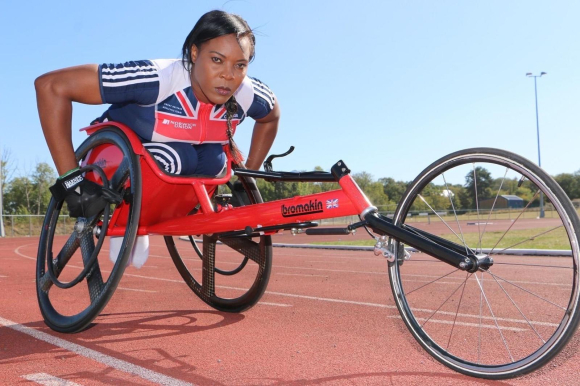
Anne Wafula Strike, MBE, a polio survivor, paralympic wheelchair racer, and disability rights campaigner. Visit Essex
The goal to eradicate polio by 2029 has never seemed more achievable. Only two countries remain endemic for wild poliovirus—Pakistan and Afghanistan—and in the first three months of 2026, only two cases have been reported globally. Since GPEI’s founding in 1988, global polio cases have been reduced by over 99.9%, preventing an estimated 20 million cases of paralysis.
“Pulling back now risks a very costly resurgence and undermines all the good that’s been done,” says Adrian Lovett, executive director for the UK, Middle East & Asia Pacific at the ONE Campaign.
Within a decade, 200,000 children could be paralyzed by polio each year without sustained funding, according to the World Health Organization.
Polio is often mild—but about 1 in 200 infections leads to irreversible paralysis. Survivors may later develop post-polio syndrome, causing progressive weakness and pain decades after infection.
The economic stakes of the disease are enormous. Failure to stamp out the disease could exceed $35 billion over the next 20 years, given the toll of disability, premature death, and caretaking needs of people paralyzed by polio.
The U.K.’s withdrawal threatens critical operations to prevent the disease, says Lovett. Vaccination campaigns in Pakistan and Afghanistan could scale back, surveillance systems across Africa may weaken, and early warning systems for outbreaks could disappear.
These efforts have been key to GPEI’s successes, which are often the result of boots-on-the-ground efforts to deliver the necessary vaccines to some of the most hard-to-reach parts of the world, says Lovett.
“Community health workers are literally trekking across forests and across streams to get to some of the hardest-to-reach communities. These people are heroes, and they really deserve all of our support.”
Wafula Strike understands the lifechanging value of this work firsthand. In the village where she grew up—before GPEI was founded—knowledge about the disease was limited. Polio vaccines were scarce, and slow to reach the village due to impassable roads. Some would arrive expired. Some people got them; others didn’t. Those paralyzed by the disease faced harsh stigma and many, including herself, were driven from their villages.
Preventing children’s chances to avoid this devastating disease is “not something we should sit and wrestle about,” she says. “It’s frustrating because the U.K. had been a great ally.”
Over three and a half decades, the U.K. has contributed $1.8 billion to polio eradication and been GPEI’s largest contributor.
The U.K. government claims it will continue supporting polio eradication through separate funding to Gavi and WHO. In the face of polio detected in British wastewater—twice in early 2026—the country has invested in improving domestic surveillance and vaccination. While “sufficient” immunization rates have so far prevented human cases in the U.K., the country is still vulnerable to new cases.
While domestic efforts are valuable, “no entity can finish the work of polio eradication by themselves”—and the global partnership of GPEI allows actors to benefit from one another’s strengths, Huseynov explains. Different GPEI partners bring different strengths to the mission, he explains: “Gavi is procuring vaccines, but is not a technical agency. WHO is a technical agency, but lacks funds, supplies, and operations” which can be supplied by other partners, like the Gates Foundation. “Only through consolidated efforts is eradication feasible.”
But the U.K.’s exit could also weaken the partnership by sending a dangerous signal, he adds. With prior funding cuts from the U.S. and others, there are fears of a domino effect: “It may cause an avalanche of cuts” that jeopardize the goal of eradicating polio. GPEI’s budget has already been cut by more than 30% due to major funding reductions by the U.S. and Germany, another top GPEI contributor, which has reduced contributions from $43 million (€37 million) in 2024 to $27 million (€23.2 million) in 2026.
Advocates are pushing for the government to rethink its defunding of GPEI—emphasizing that the U.K.’s steep aid cuts aren’t technically legal.
Since 2015, a bipartisan law has mandated that the U.K. spend 0.7% of national income on overseas development assistance. Since 2021, both Conservative and Labour governments have failed to meet this legal obligation, dropping funding first to 0.5%, now to a historically low 0.3%.
Every 0.1% cut equates to $4 billion (£3 billion), and getting back to the legal requirement would free up $16 billion (£12 billion) in development aid. Renewing funding for the U.K.’s polio commitment would require $134 million (£100 million)—“a tiny fraction of what’s been cut,” says Lovett.
“Their legal obligation—and we think their moral obligation—is to get back to that,” he says—and surveys show that the British public support the country funding global health efforts.
In the meantime, GPEI is attempting to adapt. “We have to do different with less,” says Huseynov, which will likely mean prioritizing surveillance and vaccination campaigns in the highest-risk areas, and preparing to postpone the goal of eradicating polio by 2029. That achievement would make polio the second human disease in history to be eradicated worldwide—the first was smallpox, in 1980.
There’s hope that other countries will step in—such as Australia, Spain, Canada, and Korea—who are “still looking to use their development assistance funds in a very positive way,” says Lovett. New funders are emerging—Saudi Arabia, UAE, Japan, and the European Investment Bank have all made recent contributions, and the Gates Foundation continues to match certain donations. But the hope was that new commitments would add to existing ones—not replace them, says Huseynov. “Loss of U.K. funding will certainly be noticeable,” and every delay means more children at risk of paralysis.
“It’s not just about money,” Huseynov says. “It’s about solidarity—making sure there is sufficient attention, sufficient resources to achieve the final goal.”
Join the 50,000+ subscribers in 170+ countries who rely on Global Health NOW summaries and exclusive articles for the latest public health news. Sign up for our free weekday newsletter, and please share the link with friends and colleagues: https://www.globalhealthnow.org/subscribe.
A health worker administers polio drops to a child on the first day of a nationwide week-long poliovirus eradication campaign in Karachi, Pakistan, on September, 1, 2025. Asif Hassan/AFP via Getty Images