
A Better Solution for Sickle Cell Care in Africa Amid Aid Cuts?


This story was supported by the Pulitzer Center.
KAMPALA AND KAYUNGA, UGANDA—Olivia Nansamba sits on a narrow hospital bed, her 6-month-old son in her arms, her young daughter nestled beside her. She traveled two hours from her village to this clinic at Kampala’s Mulago National Referral Hospital. Her baby, Melvin, had a fever, and is pale, weak, and wailing.
Melvin, diagnosed with sickle cell disease, is suffering from severe anemia and needed a blood transfusion. Nansamba tells the physician she is alone raising the children and breaks into tears.
“Sickle cell disease is a very terrible disease. You cannot manage it yourself,” says Nansamba, lifting up her baby’s swollen, bandage-wrapped hand. “Sometimes the baby can fail to breathe. Sometimes there’s pain, pain, pain.”
The hospital’s Sickle Cell Clinic offers patients care for the debilitating disease, including pain medication, blood transfusions, penicillin, and the drug hydroxyurea, which reduces pain crises. But many of the more than 20,000 Ugandan children born with sickle cell each year don’t get such care. Across Africa, that number expands to 300,000–400,000. And, depending on the location, 40%–80% of those who inherit the blood disorder and aren’t treated will likely die before age 5, says Ruth Namazzi, MD, a lecturer in the College of Health Sciences at Makerere University in Kampala.
In the crowded sickle cell ward, a girl about 5 years old in a yellow dress inches her walker between rows of hospital beds. Some are shared by two children, yet this is a calm day, with just 60 acute patients instead of the usual 80–100. That’s partly because it hasn’t rained lately, doctors say. Rain makes the pain worse.
The girl is learning to walk again after a stroke, a common complication of the inherited blood disorder. Pediatric hematologist Anne Akullo, MD, encourages her: “See, we are doing well.”
Akullo later says the child may need a walker for the rest of her life. “The damage has happened,” she says. Sickle cell patients as young as 2 can experience strokes, which peak around age 4–5. The first one increases the risk for additional strokes, as well as potential organ damage.
The young girl may regain some motor skills with aggressive physical therapy, Akullo says.
Despite the disease’s impact, it’s so neglected that it doesn’t appear on the WHO’s list of neglected diseases, notes Joseph Lubega, MD, MPH, director of Texas Children’s Global Hematology-Oncology Pediatric Excellence (Global HOPE) program. And sickle cell deaths are routinely attributed to malaria, pneumonia, or other diseases, ignoring the underlying cause, he says. “Without screening them, it’s as though they are unseen kids,” he says. “They just don’t exist.”
A persistent stigma attached to sickle cell disease has long prevented it from drawing more attention and funding. Myths that the disease is “synonymous with death,” can be spread by touching, or has a spiritual cause isolate those with the disease. Few leaders are willing to reveal that they have sickle cell disease and advocate for greater resources, says Lea Kilenga Bey, executive director of the Africa Sickle Cell Organization. “If the perception is that not very many people are affected, then the perception is that not many people need this help that we are asking for,” says the 37-year-old Kenyan, who has the disease. “If everyone is screaming about cancer and diabetes and epilepsy, then there’s more attention going there. The loudest disease wins.”
Making things worse: There’s little money to help African children with sickle cell in an era of slashed international health funding, led by $9 billion in U.S. global health cuts in 2025 alone.
With the complexities of this global disease, there is no panacea. But what is possible?
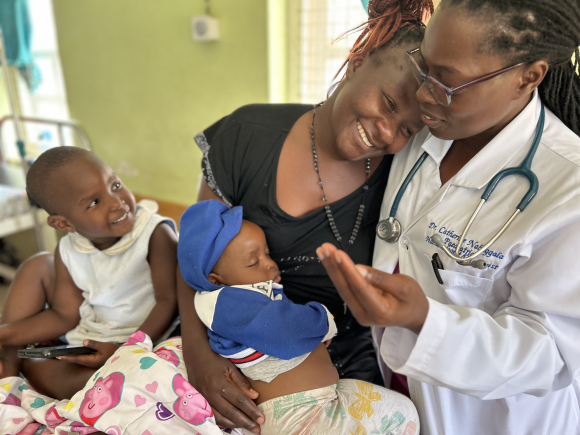
Catherine Nabaggala, MD, consoles Olivia Nansamba whose son Melvin had a blood transfusion to treat sickle cell anemia. Joanne Cavanaugh Simpson
Sickle cell disease is a brutal killer, causing 376,000 deaths every year worldwide. Some 7.7 million people live with the disease—about 80% of cases are in sub-Saharan Africa. An estimated 1%–3% of African children are born with the disease.
The disease originates from a genetic variation that causes red blood cells to change from pliable discs into stiff, brittle crescents that jam the smallest blood vessels. The result can be bouts of extreme pain (a “full-body migraine” as one researcher describes it) as well as jaundice, inflammation of the joints, a reduced immune response, and damage to the kidneys, lungs, and heart, and other organs.
Among the barriers to care is a clinical mindset that only specialized hematologists and expensive interventions can help. Sickle cell became a “specialist disease” because evidence-based treatments emerged in the U.S. and other developed countries, where it is a relatively rare disease. New treatments like gene therapy ($2 million to $3 million) and bone marrow transplants ($60,000 in India to $400,000 and more in the U.S. for the initial procedure only) offer promising results but are prohibitively expensive for all but the rich.
Wealthy African parents desperate for a solution, for example, find their way to Texas Children’s Hospital in Houston and into Lubega’s office. They are willing to pay any price to spare their children extreme pain. Lubega often asks if their child is taking a 20-cent daily dose of penicillin, which can prevent life-threatening infections. “The answer is no, but they’re here to spend millions of dollars to get a transplant in the U.S.,” he says.
Restricting care to specialists and costly treatments grossly limits the number of children who can be helped, Lubega notes. It also overloads sickle cell clinics at top-tier hospitals like Mulago. Lubega is confronting these problems by radically boosting access to treatment for sickle disease. His project: Deliver care in regular government clinics, where trained health care workers can screen and provide key meds to help children live longer, better lives.
“There are many fancy things you can do, but primary care can take care of the bulk of the issues––and at a very low cost,” he says. “So that’s our mission.”
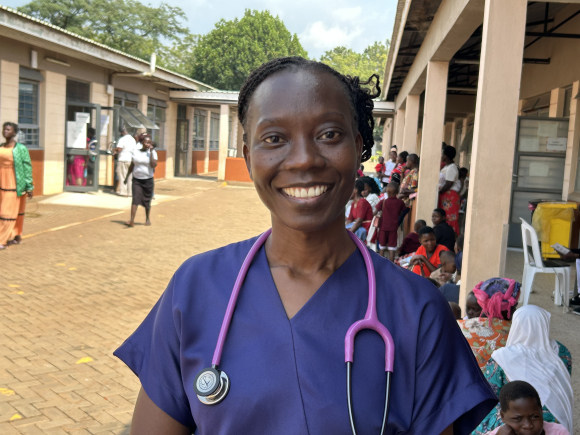
It’s too soon to say if the project is helping sickle cell patients live longer, but hospital admissions for complex cases have fallen, says Anne Akullo, MD. Joanne Cavanaugh Simpson
Dozens of children with sickle cell and their families wait to be seen one morning last summer at a new clinic at Kayunga Regional Referral Hospital, about 70 kilometers northeast of Kampala. Nestled among the complex’s low buildings and shade trees, the clinic’s beige concrete building opens onto a brick courtyard.
Staff members administer blood tests that return a diagnosis in five minutes. They prescribe penicillin and hydroxyurea. Children also receive standard vaccinations at the clinic because sickle cell disease makes them especially vulnerable to diseases like Haemophilus influenzae type b, pneumococcal, and meningococcal infections.
Health workers like nurse Evelyne Numukasa educate parents and patients about proper nutrition, hydration, and other ways to reduce the risk of pain crises. Sometimes she speaks with parents who don’t know why their babies are getting sick, and she explains the disease and treatments. Today, she also talks to teenagers receiving care.
“The parents were telling me that some of them are starting to refuse to take the drugs; they don’t understand why they are taking them,” Numukasa says, so she counseled the teens directly. “I had to take them through why they need to take their daily drugs, why they need to take in their daily foods, water, juice, and why they need to go to school.”
Asked whether teenagers tend to think they will live forever, she replies: “Here, they think they are going to die tomorrow.” After a pause, she adds: “They want to grow, so you show that, yeah, they can feel they will grow, that they are useful to the community.”
Numukasa points across the courtyard to the young woman vaccinating children. The sign on the glass door reads: “Sickle Cell Warriors Clinic.”
Inside a small room, hospital volunteer Sophia Nabisere, diagnosed with sickle cell disease as a young child, offers an example of survival to the children she vaccinates: “I tell them to beactive, to be confident. Because, you can be someone, you can be like me.” Nabisere, who is in her early 20s, also shares tips about managing the disease, especially when it’s cold. “When there’s bad weather, I know I have to put on jackets [and] heavy clothes so that I don’t get a crisis.”
Weather changes, exertion, stress, anxiety, infections like colds and flu—all can trigger pain crises, notes Titilope Fasipe, MD, PhD, co-director of the Sickle Cell Program at Texas Children’s. “You learn with time what your triggers are,” says Fasipe, who also has sickle cell disease.
Since October 2024, Lubega’s project has grown to include six sites in the Kayunga sub-region, as well as one in northern Uganda and six clinics in Tanzania. More than 13,000 newborns and infants in Uganda have been screened for sickle cell under the program, and the clinics are now ramping up to see 1,000 patients per month. (The Ugandan part of the project is led by Susan Nabadda, MD, commissioner for the National Health Laboratories.) The Kayunga team has trained more than 170 health workers in the nuances of sickle cell care. “It’s not a new model of care for them,” says Lubega, noting that it closely resembles the screening, testing, and prescribing that are routine in HIV care.
While it’s too early to say that the project is helping children live longer, the team has seen more children coming in for routine medications and a reduction in hospital admissions for complex cases, says Akullo.
The primary care strategy for sickle cell disease care is an effective model, especially in low-resource areas, says Mark Gladwin, MD, a sickle cell expert and dean of the University of Maryland School of Medicine. “Just the basic [delivery] of penicillin prophylaxis, vaccination, sanitation, and hydroxyurea would bend the curve and is very feasible at the general practitioner” level, Gladwin says. “You don’t want an American model. You really want a population health model.”
A scaled-up version of Lubega’s project that sought to bring care to 1 million children in Africa’s 10 hardest-hit countries came close to winning a $100 million award from the MacArthur Foundation. As one of five finalists from nearly 900 accepted applications, the project did receive $1 million to continue its work. Lubega has found encouraging signs elsewhere, including appointment of a national sickle cell coordinator in Uganda and a $300,000 increase in the national budget for hydroxyurea. Last month, Diana Atwine, permanent secretary of the Ministry of Health, announced that Uganda was initiating mandatory sickle cell disease screening in newborns. The announcement followed Africa CDC and Global HOPE’s launch last May of A New Day for Children with Sickle Cell Disease to expedite the integration of sickle cell care into primary care settings in countries across the continent.
The advances reflect a new determination by African leaders to confront sickle cell disease, Lubega says, adding: “When we talk to the ministry officials in Tanzania and Uganda, they look at this and they say, ‘This is going to be our example that Africa has come of age. We can take charge of our issues, and we are going to do this our way, and not because the U.S. government or someone else tells us to do it.’”
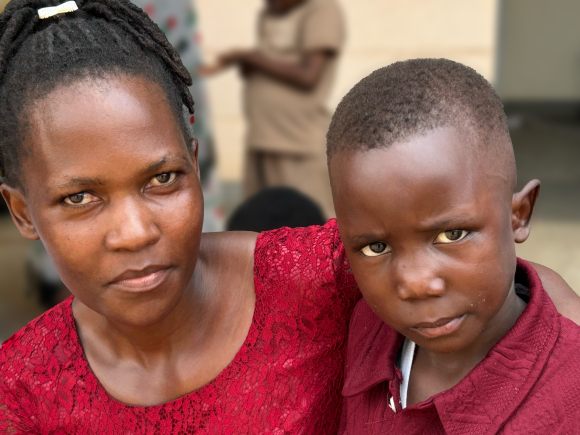
“Sometimes, I give him courage that maybe one day he will be okay,” says Hamida Birike, mother of Blessing Kisakye Haric. Joanne Cavanaugh Simpson
Sitting on a white plastic chair in the Kayunga clinic’s courtyard last summer, Hamida Birike recalls the day about five years ago when her world came undone. When her son Blessing Kisakye Haric was 9 months old, she noticed his hands started swelling. She took him to the hospital and learned he had sickle cell disease. “When the father heard that the boy is having sickle cell, he disappeared,” says Birike, who cherishes moments watching her son ride a bicycle and play with friends.
She struggles to keep up with his medications because she lacks money or the drugs aren’t available at the local pharmacy. At times, she can’t pay even for an egg or porridge for the now 6-year-old Blessing to eat, so she gives him water. Other times, she imagines a better future where he will be healthy, and maybe even become a doctor.
“Sometimes,” she says, “I give him courage that maybe one day he will be okay.”
Join the 50,000+ subscribers in 170+ countries who rely on Global Health NOW summaries and exclusive articles for the latest public health news. Sign up for our free weekday newsletter, and please share the link with friends and colleagues.
Olivia Nansamba holds her son Melvin’s bandaged, swollen hand as he rests. Joanne Cavanaugh Simpson