
Frontline Genomics With AI: Nanopores, Lifesaving Diagnostics, and Squiggles

When a cluster of four suspicious bloodstream infections broke out among newborns at New Zealand’s Wellington Regional Hospital in early 2024, clinicians decided to take a closer look using an AI-supported gene sequencing tool.
“On paper, the infections—identified as Klebsiella pneumoniae based on standard culture and mass spectrometry—looked ordinary,” recalls Rhys White, microbial genomics scientist at the New Zealand Institute for Public Health and Forensic Science (PHF Science), the country’s government-owned public health laboratory service. "But seeing several of them so close together on the same unit was unusual, as was the fact that they showed no signs of antibiotic resistance.”
Since 2022, PHF Science has been piloting onsite genome sequencing in the hospital microbiology lab, removing shipping delays and enabling genomic results to inform infection-prevention and response decisions in a timely fashion. The Klebsiella outbreak was a perfect opportunity to use that technology.
Instead of waiting a week for whole-genome sequencing results from a reference lab to find out exactly what they were dealing with, staff trained by PHF employed a harmonica-size device known as a MinION genome sequencer.
The sequencer works by sampling DNA or RNA through nanopores, producing “squiggles” that contain information about the nucleotide sequence. But the raw squiggles can’t be understood without a special computer program, known as a base caller, to interpret them.
When nanopore sequencing first came out in 2014, the software and mathematical models used to interpret squiggles often struggled to tell one DNA letter from another, so turning those “squiggles” into a usable genome could take 12–48 hours.
Today, thanks to faster sample preparation and powerful AI-based software, a draft bacterial genome can be produced in as little as two to four hours (though in routine hospital settings, turnaround is typically several hours to a day).
A Sequencing Lab in the Palm of Your Hand
In Wellington, the MinION squiggles were translated into DNA letters, revealing that three of the four isolates weren’t Klebsiella pneumoniae at all. They were Klebsiella variicola. And two of them were the same strain—ST6385—which had not been reported in clinical settings previously.
“Clinicians would have noticed the clustering,” says White, “but without sequencing there was no way to know whether the cases were linked or coincidental, since multiple Klebsiella infections can arise independently and routine microbiology cannot distinguish between those scenarios.”
Genome sequencing resolved that uncertainty by showing the isolates were closely related at the whole-genome level, turning suspicion into confirmation and justifying a targeted search for a common source. Hospital staff examined the sinks and faucets in the rooms where the affected infants had spent the most time.
Two NICU sink traps tested positive for the same ST6385 strain. Staff were unable to say whether the infants had contaminated the sink traps, or whether the sinks served as the source of their infections. The sinks were disinfected, cleaning protocols for shared equipment were updated, and hand-hygiene rounds were intensified. No further cases occurred after the intervention.
Wanted: Dead or Alive
On the other side of the world, Lara Urban’s group at the Helmholtz Artificial Intelligence Cooperation Unit in Munich, is using machine learning to go beyond identifying a microbe’s species to assessing whether the microbes in a sample are actually alive.
Instead of analyzing DNA sequences, the team trains neural networks on thousands of raw nanopore squiggles to learn the differences between living and dead pathogens. “A doctor or a food-safety inspector doesn’t just want to know what was there,” Urban says. “They need to know what’s alive and still capable of causing harm.”
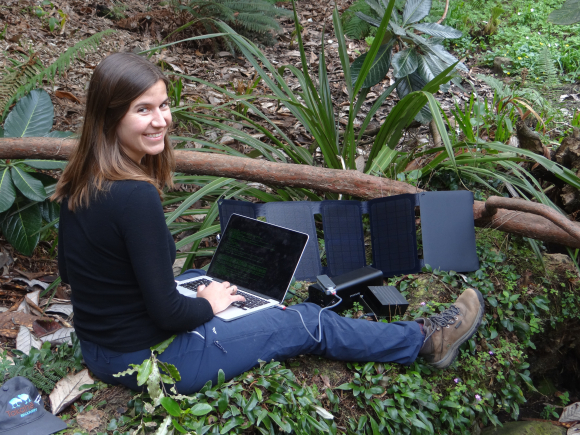
Lara Urban runs a genome sequencer in the field. Courtesy: Lara Urban
In clinical settings this can be crucial. By the time a patient’s sample is sequenced, they may already have started antibiotics. The drugs may have killed the pathogen, but its DNA can still show up in the results, creating the false impression of an ongoing infection. “If we can distinguish dead cells from live ones,” Urban says, “we avoid unnecessary changes to treatment. And if the signal shows the organism is still viable, that’s a red flag for possible antibiotic resistance and a cue to adjust therapy.”
For Urban one of the main advantages of the MinION system is its speed. “You don’t have to wait for all the data to be generated before you start analyzing,” she says. “That’s crucial in outbreak settings or remote areas where you don’t have access to high-performance computing or cloud servers.”
Although the viability work is still at the proof-of-concept stage, Urban’s group has begun applying it in collaborations with clinicians in Munich and Zurich.
“We’ve also shown in clinical studies that real-time nanopore sequencing can detect resistance markers earlier and more sensitively than routine methods,” Urban says, “with the potential to influence treatment decisions.”
AI Supported Genomics in Low-Income Settings
Urban and her team are in discussions with the Africa Centres for Disease Control and other partners to explore how this innovation could support genomic surveillance in lower-income settings. Across sub-Saharan Africa, more than half of countries now report in-country sequencing capacity, with public health labs and university hubs training local teams. Over the past decade, portable, low-cost sequencing has surged and has been deployed in Ebola, Lassa, and SARS-CoV-2 outbreaks.
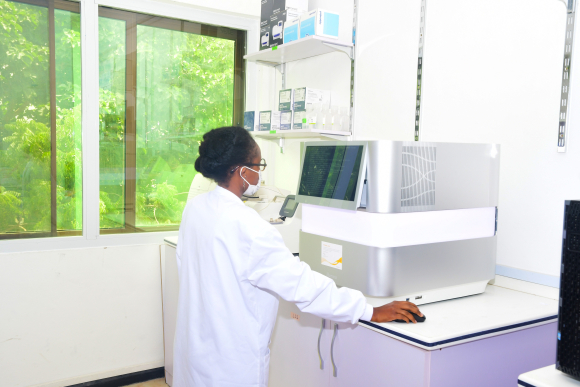
A researcher from the West African Centre for Cell Biology of Infectious Pathogens runs a genome sequencer at their laboratory. Courtesy: WACCBIP
The technology has made a huge difference. “During the 2014 Ebola outbreak, samples from Guinea had to be shipped to Paris for confirmation—a process that could take weeks,” says Christian Happi, director of the African Centre of Excellence for Genomics of Infectious Diseases (ACEGID) in Nigeria. By using a portable genome sequencer, an ACEGID team was able to confirm a suspected Ebola case in three days. “That speed saved thousands of lives,” Happi says.
Since then, ACEGID has sequenced Africa’s first SARS-CoV-2 genome within 48 hours of detection, trained thousands of scientists from across the continent, and helped national labs stand up real-time sequencing pipelines.
But for now, most analysis still depends on traditional bioinformatics tools. Happi is well aware of the potential for AI-supported genomics and diagnostics, but he cites various obstacles to their development. “The main limitation is infrastructure,” he says. “Data storage, computing power, and internet access. In much of Africa, on-premises analysis is still more reliable than cloud-based systems because of inconsistent connectivity and power supply.”
In Ghana, scientists at the West African Centre for Cell Biology of Infectious Pathogens (WACCBIP) are designing tools for the realities of rural clinics. Gordon Awandare, WACCBIP’s director, views the effort as part of a broader plan to build sustainable genomic capacity in Africa. WACCBIP has become a major hub for training in genome sequencing and bioinformatics, supporting spoke labs in West and Central Africa to establish capacity for genomic surveillance. It has also provided a platform for young scientists to develop innovative solutions for Africa’s health care challenges.
Among them is Felix Ansah, a postdoctoral researcher working on a low-cost molecular diagnostic device designed for use far from a conventional laboratory. Instead of using polymerase chain reaction (PCR), the device relies on a nucleic-acid amplification method. In principle, a small sample of blood or saliva can be added to a disposable cartridge, which can be configured to look for one or several pathogens.

A team of West African Centre for Cell Biology of Infectious Pathogens researchers share fluorescent assay images as part of scientific outreach efforts. Courtesy: WACCBIP
Ansah’s prototype does not sequence whole genomes, but it applies the same principle of detecting pathogens by their genetic signatures, using low-cost chemistry and an amplification step that does not require electricity. The readout is a simple color or fluorescence change, captured by a phone camera and analyzed by a small AI model rather than a laboratory technician.
The system is still at the prototype stage and has not yet been evaluated in large clinical trials, but it reflects a wider direction of travel in global diagnostics: Researchers are exploring whether AI running on laptops and ordinary phones could help extend DNA-based testing into settings where sequencing facilities and stable power are unavailable.
Ansah is optimistic. “As users send images back, we retrain the model—it keeps learning,” he says. “The technology will effectively put a diagnostic expert in every clinic.”
Gary James Humphreys is a Geneva-based public health writer and editor who spent more than a decade shaping news coverage for the Bulletin of the World Health Organization, reporting across a wide range of global health topics and interviewing leading figures in the public health space.
Join the 50,000+ subscribers in 170+ countries who rely on Global Health NOW summaries and exclusive articles for the latest public health news. Sign up for our free weekday newsletter, and please share the link with friends and colleagues.
Rhys White, microbial genomics lead at Public Health and Forensic Science, and a colleague review a pangenome graph showing a key antibiotic-resistance gene. Courtesy: PHF Science / Kimberley Kan