
New Year’s Resolutions From the ‘Mother of Injury Prevention’
After a bruising, brutal year for public health, many of us are reimagining the field and rebuilding our careers. Our heroic pioneers can offer inspiration.
Among them is Sue Baker, who’s known as the “Mother of Injury Prevention,” though she rejects this moniker, preferring to share credit with her peers. When Baker, a professor emerita at the Johns Hopkins Bloomberg School of Public Health, began her career in 1968, injuries were still “accidents”—inevitable acts of fate. Car seats were primitive, smoke detectors were rare, and helmets an afterthought. But with courage, curiosity, and grit, Baker changed all that. As we make New Year’s resolutions that will guide our careers in these unprecedented times, her legacy illuminates three important lessons.
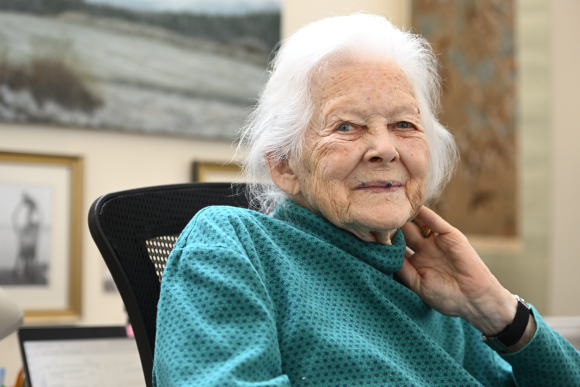
Three key, career lessons emerge from the six-decade career of injury prevention pioneer Sue Baker. Dec. 17, 2025. Will Kirk
1. Don’t be afraid to take on new challenges.
A 36-year-old homemaker with three young children, Baker blazed an unlikely path to public health hero. After overhearing the chair of the then-Department of Chronic Diseases at Johns Hopkins say he was looking for computer programmers, she signed up for a class the next day. That challenge cracked open a window into public health and fostered her desire to pursue an MPH—while raising a family. She convinced the dean to let her do it part time, opening the door for more working parents.
Baker studied something new—“accidents” in people with chronic diseases. As she mined data at the Baltimore City morgue, she stumbled upon dead, tattooed drivers. She published an article in 1971 showing that they were more likely to have caused their own deaths than drivers without tattoos, explained by the correlation between tattoos and alcohol consumption.
When she mailed the paper to Bill Haddon, head of the National Highway Traffic Safety Administration (NHTSA), she included a request for $10,000—seed money that sowed the field. The guardrails came off, and she expanded her research beyond road safety, helping to put injury prevention on the map.
“I never followed the path that was expected of me,” she said recently. “Strike out for the things you really want to see happen, even if it seems unlikely, because some of them will work out.”
2. Go to the field to understand it.
“We barely know the front of a truck from the back,” Baker told colleagues on the U.S. Department of Transportation’s Truck and Bus Safety Advisory Committee in 1976. “We ought to know more about trucks before opining on safety.” In response, General Motors invited the entire committee to its Arizona proving grounds. Sue was assigned to drive “The General,” the biggest, baddest, 12-speed, 18-wheeler. Her students called her “Fearless Baker,” though she admits being nervous that day.
The experience was fodder for testimony. Wielding a truck steering wheel at a 1979 NHTSA public meeting, she described a driver jackknifing over it at 55 m.p.h., his chest slamming into the steering column with bone crushing force. She implored legislators to improve safety “until we can no longer look at new trucks with the realization that someone is going to die in one of them.”
It wasn’t Baker’s only expedition outside of the ivory tower. She learned to fly at age 50 when she studied plane crashes and spent a week on an aircraft carrier—all in the name of shoe-leather epidemiology.
3. Speak the truth – even when it’s unwelcome.
“What an unusual autopsy,” thought Baker. Blood didn’t trickle out of the patient’s abdomen, it poured. The patient’s file hid a tragic explanation: The man was brought to a hospital utterly unequipped to save him. “He should have gone to a hospital with a trauma surgeon,” she said.
With trauma surgeons, she published a commonsense recommendation: Patients with severe injuries should be transported to facilities that can treat them. That helped lay the groundwork for today’s statewide trauma and triage systems.
A past president of the Association for the Advancement for Automotive Medicine (AAAM), mostly composed of doctors, felt attacked by her descriptions of errors made in under-resourced settings. “You have opened Pandora’s box!” he declared.
Baker didn’t waver. “Do you want to close the lid and sit on it?”
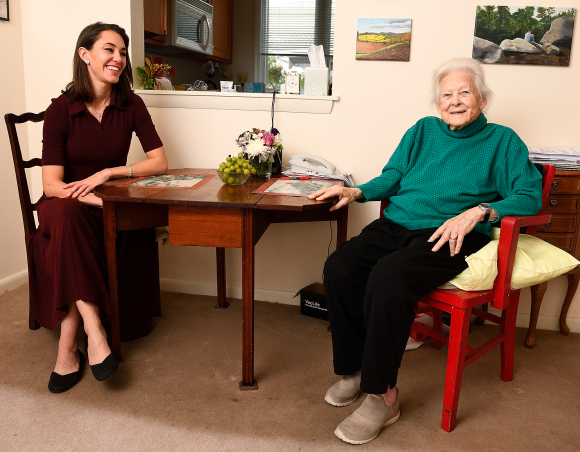
Writer Natalie Draisin draws inspiration from her frequent conversations with Sue Baker. Will Kirk
From motorcyclists who didn’t like helmets to trucking companies more interested in profits than safety, Baker stood up to opponents with disarming calm.
Driven by insatiable curiosity, a strong moral compass, and wry humor, Baker reinvented herself—and the field of injury prevention. In our challenging new normal, such values can underpin New Year’s resolutions that answer Baker’s favorite question: “Well, what are you going to do about it?”
As we prepare for a new, hopefully better year, Baker reminds us that the promise of 2026 lies in our willingness to think—and act—boldly.
Natalie Draisin, MPH, MBA, is director and UN representative, North America Office, FIA Foundation; advisor, Health & Safety Hub, WHO and International Transport Forum; and an external affiliate, Johns Hopkins Center for Injury Research and Policy. She is writing a book about her mentor Sue Baker.
Join the 50,000+ subscribers in 170+ countries who rely on Global Health NOW summaries and exclusive articles for the latest public health news. Sign up for our free weekday newsletter, and please share the link with friends and colleagues.
Sue Baker spent her career preventing injuries to children, truck drivers, pilots, and others. Undated photo.